
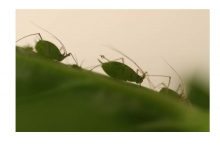
 Pea aphids Acyrthosiphon pisum [photograph by Calum Russell]
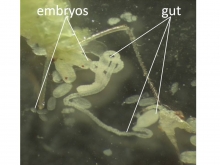 Dissection of a pea aphid

Sugar nutrition and osmoregulation of phloem-feedinginsects
Plant phloem sap is carbon-rich and, in many plants, dominated by a single disaccharide sugar, sucrose,  often at concentrations >
1 M. Phloem-feeding insects utilize the sucrose as their principal
carbon source and respiratory fuel. The high phloem sugar content also
poses a major physiological challenge: it is up to 4-5 times higher
than that of aphid body fluids. Aphids would be expected to lose water
to the gut and suffer osmotic collapse, i.e. dehydrate as they feed. We
are applying our developing understanding of sugar nutrition and
osmoregulation in aphids and other phloem-feeding insects to develop
novel control strategies against these insects, in collaboration with Georg Jander (Boyce Thompson Institute).
Three gut functions are crucial for the sugar nutrition and osmoregulation of aphids and - we hypothesize - other phloem-feeding insects: the sucrase-transglucosidase enzyme activity, sugar transporters, and the gut aquaporin. Our ongoing research on these three functions is described below.
1.1 The sucrase-transglucosidase enzyme activity
Aphids avoid osmotic collapse partly because the dietary sucrose is
modified in the gut. We have shown that the pea aphid has a gut sucrase
and transglucosidase that transform the glucose moiety of the sucrose
into long-chain oligosaccharides, so depressing the osmotic pressure of
the gut contents.
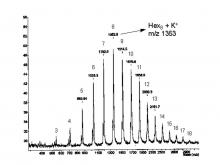 Figure. Size (number of hexose units, up to 18 shown) of oligosaccharides in honeydew of pea aphids Acyrthosiphon pisum, determined by MALDI-TOF. The aphids were reared on diets containing 0.75 M sucrose.
We have identified the aphid gut sucrase, and localized the transcript and protein to the intestine, i.e. distal to the stomach.
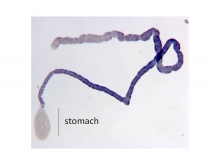
Figure. Transcript of the pea aphid gut sucrase (ACYPI000002) localized to the intestine, distal to the stomach (blue). More details available here.
We have demonstrated that aphid osmoregulation requires the functional gut sucrase. Acarbose is a potent inhibitor of the aphid gut sucrase in vitro and in vivo. When pea aphids are fed on diets with 5 µM acarbose, the osmotic pressure of their hemolymph (blood) rises significantly and the aphids die in 2-3 days.
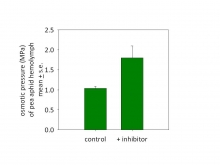
Figure. Impact of 5 µM acarbose on the hemolymph osmotic pressure of pea aphids fed for 2 days on diets containing 0.75 M sucrose. The acarbose-treated aphids were very dehydrated; some individuals were so shrivelled that we could not obtain hemolymph from them. More details available here.
1.2 Sugar transporters
Sugar transporters mediating the transfer of glucose and fructose
across
the gut wall to hemolymph play a central role in the carbon nutrition
and osmoregulation of aphids. The pea aphid genome has 25 predicted
hexose transporters (see figure below), five of which have significantly
enriched expression in the gut. One of these transporters, Ap_ST3 has
been investigated in detail: it is a low-affinity uniporter for fructose
and glucose that does not depend on Na+ or H+ for activity (more
details available here).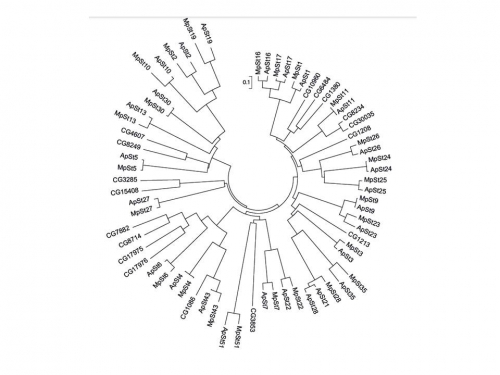
Figure Phylogenetic analysis of sugar transporters in the aphids Acyrthosiphon pisum (Ap) and Myzus persicae (Mp) with Drosophila melanogaster (CGs) (data of Xiangfeng Jing and Douglas, unpub).
1.3 Aquaporins
Aphid osmoregulation is also dependent on the function of a gut
aquaporin (water channel). We have identified the aquaporin gene aqp1 (ACYPI006387) and localized the transcript to the stomach and distal intestine. 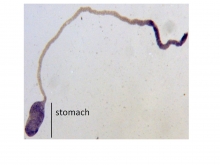
Figure. Transcript of the pea aphid gut aquaporin (ACYPI006387) localized to the stomach and distal intestine (blue). More details available here.
The osmotic pressure of the aphid hemolymph is elevated when expression of the gene aqp1 is depressed by RNAi.
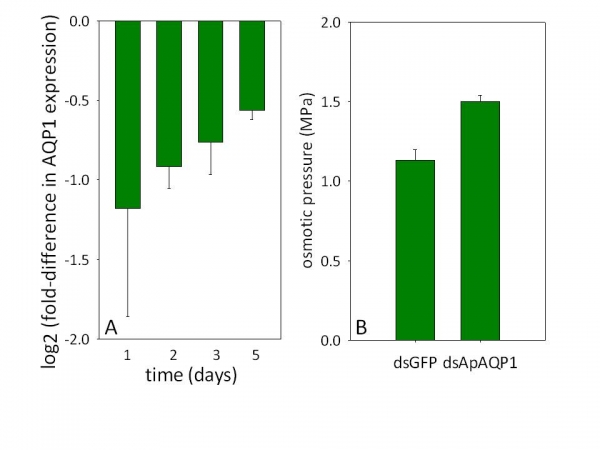 Figure. Impact of RNAi on pea aphids. A. Transcript abundance of the aquaporin gene aqp1 in aphids administered dsRNA-aqp1 relative to those administered dsGFP (data are normalized to the reference gene ßTUB). B. Hemolymph osmotic pressure is significantly elevated at 2-3 days after administration of aqp1 dsRNA
to aphids. RNAi-mediated knock-down of gene expression in aphids has
the predicted phenotypic effect, even though the reduction in aqp1 expression is incomplete and transient. More details are available here.
The aqp1 gene is one of just two aquaporin genes in the pea aphid genome. aqp2
(ACYPI009194, Gene ID: 100168499) is expressed in the fat body and
bacteriome, and is an aquaglyceroporin that transports both water and
polyols.
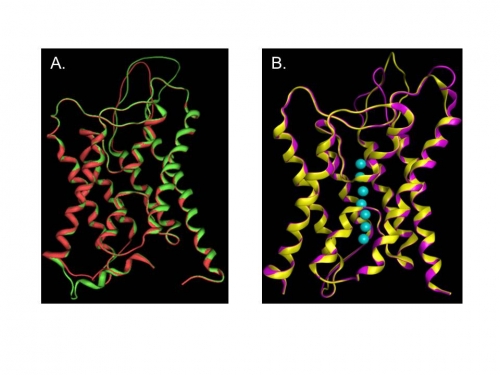 Figure Homology
models of pea aphid aquaporins. A. AQP1 (red) superimposed on bovine
AQP1 (green). B. AQP2 (fuschia) superimposed on human AQP4 (yellow),
with transport pore indicated by blue spheres. For more details, see Shakesby et al. (2009) and Wallace et al. (2012).