
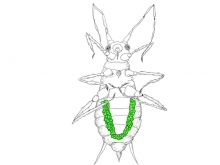
 The symbiotic bacteria Buchnera are located in specialized cells called bacteriocytes (shown green in figure) in the aphid body cavity. [Drawing by Tomás Lazo]
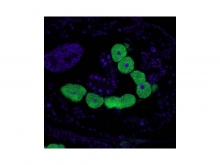 FISH micrograph of sectioned black bean aphid Aphis fabae hybridized with FITC-labelled DNA probe specific to 16S rRNA of Buchnera (green), with the DNA stain DAPI (blue) as counterstain. [Micrograph by Simon Chandler]
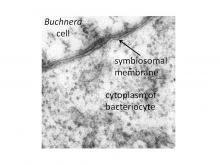 Each Buchnera cell is separated from the bacteriocyte cytoplasm by three membranes, interpreted as the bacterial inner membrane, bacterial outer membrane and the outermost aphid symbiosomal membrane (arrow). All metabolites transferred between the host and symbiont must cross these three membranes. [Micrograph by Angela Douglas]
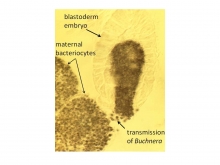 Buchnera cells are transmitted vertically from the maternal bacteriocytes to the blastoderm embryos in parthenogenetic aphids (shown) or to the cytoplasm of sexual eggs. [Micrograph by Tom Wilkinson]
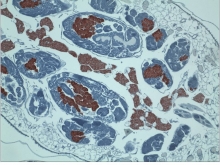 Immunolocalization of GroEL protein of the bacterium Buchnera in sectioned pea aphid, using a monoclonal antibody we raised against recombinant Buchnera GroEL. GroEL (red) is detected in Buchnera localized in aphid bacteriocytes in the body cavity and embryos [Bouvaine et al. 2011. J. gen Virol 92: 1467

The association between plant sap feeding insects and their intracellular bacterial symbionts
The symbiotic bacteria provide nutrients to their insect hosts
Various insects possess beneficial microorganisms housed in specialized cells called bacteriocytes. Most of these microorganisms have a nutritional role. In plant sap feeding insects, the microorganisms provide essential amino acids. For example, the pea aphid
obtains 4 x its total nitrogen requirement from the phloem sap of its
host plant Vicia faba (fava bean), but the essential amino acid
content is very low (see Figure).
Figure. Amino acid requirement for protein growth of the fourth (final) larval stadium of the pea aphid larvae. The requirement for most non-essential amino acids (other than glycine) is met from the diet of phloem sap, but the greater part of the essential amino acid requirement is met by the symbiotic bacterium Buchnera (the endogenous source).
Nutritional interactions across the interface between the Buchnera bacteria and bacteriocyte
The supply of essential amino acids from Buchnera bacteria to the aphid host is founded on dynamic interactions between the bacterial cells and bacteriocyte (the aphid cell that houses the bacteria).
By annotation of the genomes of the pea aphid and its Buchnera symbiont, quantitative transcriptomics and proteomics of the bacteriocyte, together with metabolomics and metabolic modeling, we have inferred that 58 metabolites are transferred between the partners (Wilson et al. 2010, Poliakov et al. 2011, Macdonald et al. 2012, Russell et al. 2013).
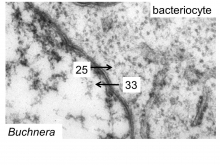
Figure Metabolite exchange across the symbiotic interface of the pea aphid-Buchnera symbiosis. Number of transferred metabolites, inferred from metabolic modeling. Macdonald et al. 2012.
The 33 inputs to Buchnera include all the nutrients required by Buchnera for growth and the precursors for the synthesis of essential amino acids released back to the host. Metabolic exchange is substantial because Buchnera is metabolically-fastidious, and the biosynthetic pathways for 5 of the 10 EAAs are shared between Buchnera and aphid with shuttling of intermediates between the partners exchange across the symbiotic interface.
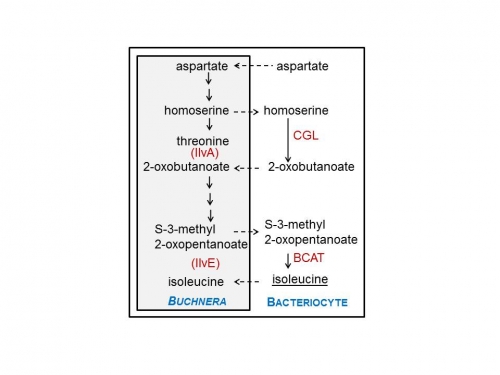
Figure Shared biosynthesis of the essential amino acid isoleucine between Buchnera and insect, with aphid cystathione-gamma-lyase (CGL) and branched chain aminotransferase (BCAT) predicted to mediate the reactions of ‘missing’ Buchnera IlvA and IlvE. For further details, see Wilson et al. 2010 and Russell et al. 2013.
We have also demonstrated nitrogen recycling in the aphid-Buchnera
symbiosis, i.e. that host nitrogenous waste (ammonia) is utilized in
the synthesis of essential amino acids. However, nitrogen recycling is
mediated by host enzymes, specifically transaminases e.g. BCAT, that
utilize carbon skeleton that can be synthesized only by the Buchnera symbiont. 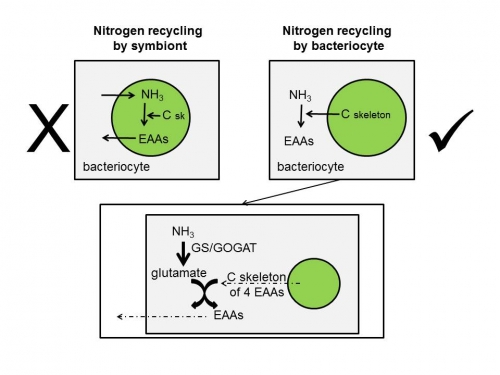
Figure Alternative scenarios of symbiotic nitrogen recycling involving an intracellular symbiont (green). Microbial symbionts in various animals are hypothesized to recycle nitrogen, but Buchnera is very limited capacity for ammonia assimilation. In the pea aphid, the bacteriocyte incorporates waste ammonia via glutamine synthetase/glutamate synthase (GS/GOGAT) and linked transaminases into symbiont-derived carbon skeletons to generate essential amino acids (specifically the three branched chain amino acids and phenylalanine). Further details in Macdonald et al. 2012.