

 Lab Lunch at College Town Bagels on 1st May
 First day in the new lab, 28 January 2024


Publication
September 22nd, 2014
Russell CW, Poliakov A, Haribal M, Jander G, van Wijk K and Douglas AE, 2014. Matching the supply of bacterial nutrients to the nutritional demand of the animal host. Proceedings of the Royal Society of London B, 281 (1791):20141163. Pubmed
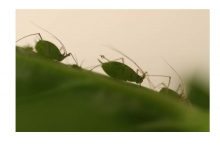 Various animals derive nutrients from symbiotic microorganisms with
much-reduced genomes, but it is unknown whether, and how, the supply of
these nutrients is regulated. Here, we demonstrate that the production
of essential amino acids (EAAs) by the bacterium Buchnera aphidicola in
the pea aphid Acyrthosiphon pisum is elevated when aphids are reared on
diets from which that EAA are omitted, demonstrating that Buchnera scale
EAA production to host demand. Quantitative proteomics of bacteriocytes
(host cells bearing Buchnera) revealed that these metabolic changes are
not accompanied by significant change in Buchnera or host proteins,
suggesting that EAA production is regulated post-translationally.
Bacteriocytes in aphids reared on diet lacking the EAA methionine had
elevated concentrations of both methionine and the precursor
cystathionine, indicating that methionine production is promoted by
precursor supply and is not subject to feedback inhibition by
methionine. Furthermore, methionine production by isolated Buchnera
increased with increasing cystathionine concentration. We propose that
Buchnera metabolism is poised for EAA production at certain maximal
rates, and the realized release rate is determined by precursor supply
from the host. The incidence of host regulation of symbiont nutritional
function via supply of key nutritional inputs in other symbioses remains
to be investigated.